
★★★★★
Sciatica“I was terrified of making my sciatica worse. Teejay worked around every concern and every session felt purposeful and safe. Six months later I’m back to full mobility.”
"When a client tells me they’re terrified of doing the wrong exercises for their sciatica — they’re absolutely right to be. That fear is based on experience."
Understanding sciatica
Sciatica is not a diagnosis — it is a symptom. Sciatic pain radiating down your leg is the result of something compressing or irritating the sciatic nerve. The correct treatment depends entirely on identifying exactly what that something is.
This is why the wrong exercises make sciatica worse. An exercise that helps disc-related sciatica can significantly aggravate piriformis syndrome. It is essential that whoever prescribes your exercises understands not just that you have sciatica — but why you have it.
"Sciatic pain can arise from multiple causes simultaneously. A thorough assessment is not optional — it is the foundation of every successful sciatica treatment programme."
Lasting sciatica relief requires two things working together. First, nerve irritation must be reduced through appropriate soft tissue treatment. Then, the movement patterns and muscle activation maintaining the problem must be corrected through the right exercises. Treatment alone is not enough — and exercise alone is not enough. The combination delivers lasting results.
Six causes — different treatments
Sciatica is not one condition — it is a symptom with six distinct common causes. The exercises that help one cause can seriously worsen another. This is why assessment before treatment is essential.
Understanding the anatomy
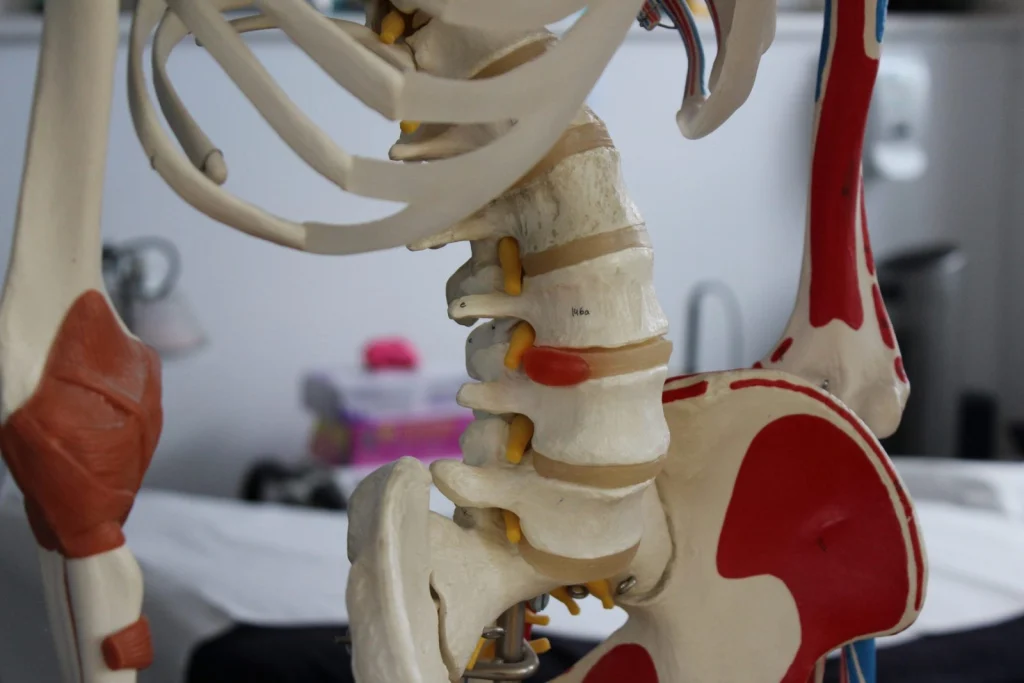
The sciatic nerve is the longest in the body. It originates at nerve roots L4 to S3 and travels from the lumbar spine through the pelvis and down each leg to the foot. Compression at any point along this pathway can cause sciatica symptoms.
The critical distinction
Many sciatica sufferers in St Albans have tried exercises from YouTube, a physiotherapist, or a standard Pilates class — and found they made things worse. This is almost always because the exercises were not chosen for their specific cause of sciatica.
Forward bending is often prescribed for back pain. For disc-related sciatica it can increase disc pressure and worsen nerve compression significantly.
Extension helps disc problems but narrows the spinal canal further in stenosis patients. The same exercise that helps one cause can severely worsen another.
Deep piriformis stretches are commonly recommended for sciatica. If the cause is a disc prolapse rather than piriformis syndrome, they can increase nerve irritation.
Introducing strengthening exercises before the acute inflammatory stage has settled can significantly set back recovery. The phase of recovery matters as much as the exercise itself.
What we assess first
The £85 Movement Assessment identifies the specific cause of your sciatica and the stage of recovery you are at. Every exercise prescribed is appropriate — and nothing is introduced that risks making your sciatica worse.
What the £85 assessment identifies
The treatment pathway
Sciatica recovery cannot be rushed. With the right approach at each phase, most clients achieve significant and lasting improvement. The sequence matters as much as the treatment.
Client results
“I was terrified of making my sciatica worse. Teejay worked around every concern and every session felt purposeful and safe. Six months later I’m back to full mobility.”
“I’ve been coming here for over a year and it’s been so helpful at keeping my back pain and sciatica at bay — in a way that none of the other therapies I’ve tried could manage.”
“After six sessions with Teejay I finally understood what was actually happening in my body. Nobody had explained it like that before — not the physio, not the osteopath, not the chiropractor.”
“I came in after a back injury and sciatica that left me in incredible pain and out of work for months. I was put on a personalised plan, and after a couple of months I’m back at work on light duties, walking better and generally in less pain.”
Getting started
Every new client begins with a Movement Assessment. Your treatment is specific to the cause of your sciatica from day one — never a generic programme.
Related pages & information
Common questions
Your £85 Movement Assessment identifies the specific cause of your sciatica. Teejay will explain exactly what is happening, what stage of recovery you are at, and what to — and what not to — do about it. No obligation to continue. Ample free parking on site.
The Sogunro Practice · Applied Pilates & Osteolates Therapy
Unit 5, Hertfordshire Business Centre, Alexander Road
London Colney · St Albans · Hertfordshire · AL2 1JG · Free parking on site