“I Tried Pilates For A Month — Here Are 6 Things I Learned.”
A sceptic’s honest account of what happens when you give Pilates a genuine month — the surprises, the contradictions, and the physical changes nobody warned him about. With clinical context added by Teejay Sogunro from The Sogunro Practice, London Colney, St Albans.
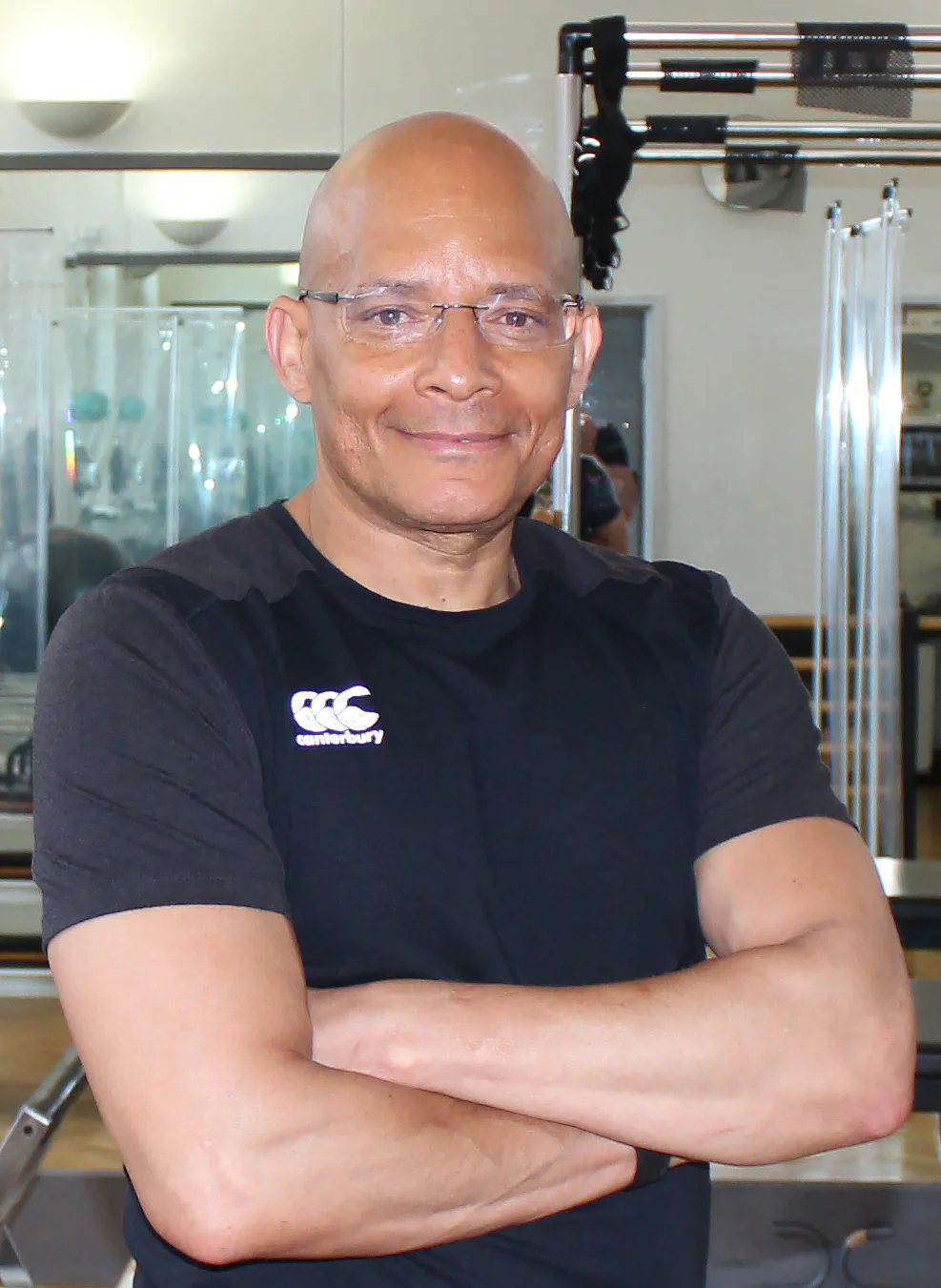
Teejay Sogunro
Founder, The Sogunro Practice · Clinical context and commentary · Published 4 Mar 2025 · Updated 27 Jul 2026 · 6 min read
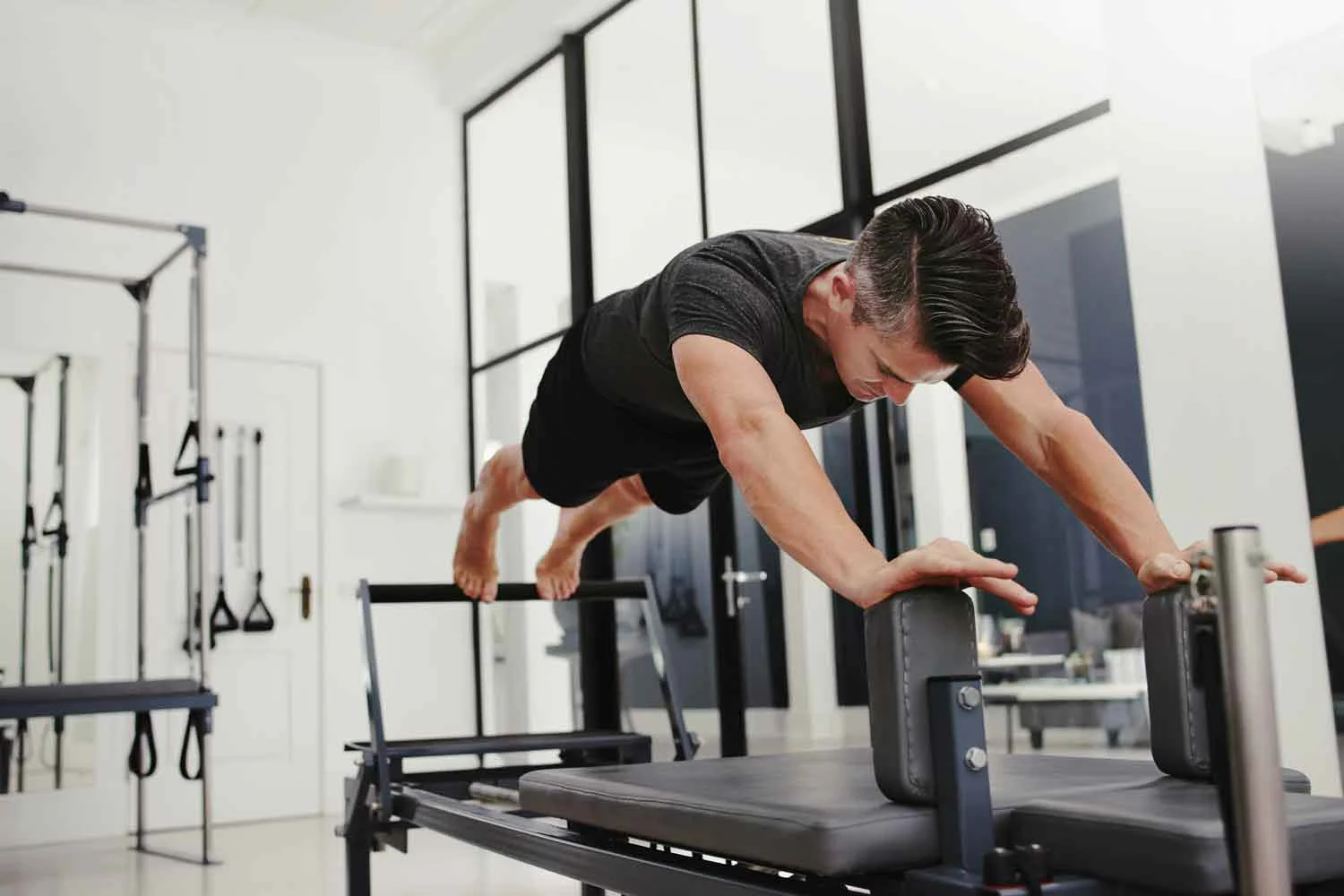
Applied Pilates on the Reformer — The Sogunro Practice, London Colney, St Albans. Max 7 clients per session.
If you had asked me 10 years ago whether I’d ever try Pilates, I would have laughed. It took some convincing from colleagues before I’d even consider it wasn’t just stretching for 45 minutes. But rugby players are earthing, elite military units are meditating — suddenly no exercise is off limits. So I gave it a month.
Sitting at 90kg, shaped like a Dorito (leg day and I have a complicated relationship) and carrying a collection of injuries from rugby collisions, I thought this might be a good opportunity to reset. I committed to regular sessions, showed up consistently, and paid attention to what actually happened to my body.
What followed surprised me on nearly every count. Here are six things I learned — with clinical context from Teejay Sogunro at The Sogunro Practice, St Albans, explaining the evidence behind each one.
My core improved — and it wasn’t the core I thought I had.
When you spend most of your training time trying to go heavier, core is an afterthought. Russian twists don’t impress anyone. But after a month of Pilates, I had definition I hadn’t seen in years — and more importantly, my lower back stopped being the thing I noticed first when getting out of bed in the morning.
The training felt completely different from anything I’d done in the gym. The muscles being worked were clearly not the ones I’d been targeting. I felt it in places I didn’t know could get sore.
“Pilates focuses on not only the rectus abdominis — ‘six pack abs’ — but also the transverse abdominis (which sits under the visible abs) and the pelvic floor. These core muscles improve posture, eliminate back pain, and allow you to lift heavier. They act as a belt around your torso and draw in your waist and back. Most typical abs exercises like sit-ups focus on the rectus abdominis only and neglect the rest.”
Frontiers in Physiology, Nov 2024 (Ko et al.): Experienced Pilates practitioners showed significantly higher core muscle activation — particularly external oblique (EO) — and superior functional movement scores compared with novices across all exercise levels. The research confirms that Pilates systematically develops the deeper stabilising layers that gym training misses.
Medicina, Feb 2025: Pilates-based core stabilisation training improved deep stabiliser muscle thickness and contraction timing, particularly in the transverse abdominis and internal obliques, as measured using rehabilitative ultrasound imaging.
Retos Journal, 2025: After 8 weeks of Pilates, participants showed measurable increases in transverse abdominis, internal oblique and rectus abdominis thickness, with experienced practitioners showing significant improvements across relaxation, hollowing and plank conditions.
The distinction between superficial and deep core is not academic. The transverse abdominis wraps around the spine like a corset and activates before any limb movement, providing anticipatory stability. Standard gym exercises rarely reach it effectively. Pilates targets it in every session — which is why back pain so often responds to the work. One qualification on the quote above: in practice, well-chosen Pilates reduces back pain for most people rather than eliminating it, and how much depends on the cause and how long it has been present. Back pain guide at The Sogunro Practice →
My gym lifts improved — without touching a barbell for a month.
This surprised me most. I’d fully expected to lose ground. In my experience, strength requires consistently moving heavy weight. A month away from the plates should have cost me. It didn’t. If anything, I returned stronger in the movements that depend on a stable base.
The explanation, once I heard it, made complete sense. The compound lifts I rely on — deadlifts, squats, overhead press — are limited by the weakest link in the chain. In most training men, that weakest link is the deep stabilisers and postural foundation. Pilates directly addresses exactly those things.
“Pilates is a great supplement to strength and resistance training as it seriously improves posture, spinal and pelvic alignment, and core strength. This is especially helpful when performing heavy compound exercises such as deadlifts and squats, where form and alignment are crucial in order to increase the load safely.”
Frontiers in Physiology, 2024 (Ko et al.): Experienced Pilates practitioners demonstrated greater movement efficiency across six Pilates exercises at basic, intermediate and advanced levels, with higher RA/EO co-contraction indices — a marker of functional stability that directly transfers to compound lifting performance.
PLOS ONE, May 2025: A randomised controlled trial with amateur male football players found Reformer Pilates produced measurable improvements in physical performance parameters over an equivalent period, supporting its use as a conditioning supplement alongside primary sport or strength training.
Practical implication: Pilates builds the foundation that strength training assumes you already have. Most people don’t. Teejay Sogunro consistently sees this in new clients who have trained for years in the gym but arrive with significant deep stabiliser deficits that are limiting both their performance and their injury resilience.
I dropped 5kg. And I wasn’t even trying to.
With summer approaching and my body composition not quite where I’d like it, Pilates turned out to be a useful lever — despite not feeling like a traditional fat-loss workout. After a month, I had lost five kilograms and a more defined mid-section had appeared as a direct result.
What makes this interesting is the mechanism. Pilates does not feel like a cardiovascular session in the way a 5k run or a gym circuit does. But the sustained muscular tension across nearly the entire session creates a cumulative calorie burn that adds up — and the interval-like quality of slow and fast movements keeps the heart rate moving throughout.
“High-intensity Reformer Pilates is a great way to drop fat, as your muscles are under tension for almost the entire session, with a mix of slow and fast movements allowing your heart rate to rise and drop, similar to interval training, and minimal rests throughout. It is intense — but the session goes by fast as it keeps you engaged throughout.”
Narrative review, ACAM 2025 (Field): A comprehensive review of Pilates research identified decreased body weight as one of the most frequently reported physical outcomes. The review covered cognitive, psychological, physical and physiological effects, with body composition changes featuring consistently across trials.
Why low impact doesn’t mean low output: Research consistently shows that the assumption “only high-cardio exercise burns fat” is incorrect. Sustained muscular control across a session — the defining characteristic of Reformer Pilates — maintains significant energy expenditure. The low joint load means the exercise can be sustained consistently, which matters far more for long-term body composition than the output of any single session.
It won’t get you jacked. And that’s not a criticism.
I need to be honest here. Substituting my regular gym sessions for Pilates caused noticeable hypertrophy decrease. I put this down to the high-repetition, low-load nature of the work. While there is some muscle gain, and while the Reformer does offer adjustable resistance, the loading profile is fundamentally different from progressive overload with heavy weights.
If sleeve-busting arms are the goal, you need to be shifting heavy weight in calorie surplus. Pilates does not replicate that. What it does replicate — and what gym training rarely addresses — is the stabilising system that makes heavy weight training safer and more effective.
Frontiers in Physiology, 2024: Pilates develops functional control and movement efficiency rather than maximal strength in the way progressive resistance training does. This is not a weakness — it is a different adaptation with different value.
Medicina, 2025: Pilates-based training improved deep stabiliser muscle thickness and neuromuscular control — adaptations that complement rather than replicate those from conventional resistance training.
The correct framing: Pilates and strength training are not competing alternatives. They address different gaps. Most gym-trained men have strong superficial muscles and weak deep stabilisers. Pilates directly corrects that imbalance. The combination produces better outcomes than either alone, which is why most serious athletes who add Pilates do so alongside, not instead of, their existing training.
Body parts I’d ignored for years got found out — immediately.
This will happen in the first session. The muscles you have been neglecting will make themselves known both during the work and in the days that follow. That soreness in places you didn’t know could get sore is not a warning sign — it is the entire point. Pilates is a total-body workout in a way that compartmentalised gym training rarely is.
Within a few sessions, those previously quiet areas began to respond. The changes were visible within two weeks and clearly measurable by four.
“Ideally you want to be doing three high-intensity Reformer Pilates sessions per week to see a really noticeable change in your strength, posture and appearance. You will start to feel the difference after two weeks, and you will start to see a visible difference after as little as four weeks.”
The clinical picture: Most training-related injuries occur not because muscles are weak, but because of imbalances between muscle groups — one side overworking to compensate for another. Pilates systematically identifies and addresses these compensations through its emphasis on unilateral and contralateral movements, where each side of the body is challenged independently. You cannot mask the weakness when the movement requires both sides to work equally.
Sports injury rehabilitation context: At The Sogunro Practice, identifying and correcting these muscular imbalances is the starting point for every sports injury rehabilitation programme. What feels like a knee problem is often a hip stability problem. What feels like a shoulder problem is often a thoracic mobility problem. The imbalance is the injury waiting to happen — and Pilates finds it before it does. Sports injury rehabilitation at The Sogunro Practice →
My posture changed. And so did the way my clothes fit.
I had heard this would happen from multiple people before I started. I treated it as marketing. But it was one of the most noticeable and genuinely useful changes from the month. The slouched shoulders disappeared. I found myself sitting straighter without thinking about it. And yes — my clothes fit noticeably better, which I had not expected to care about but absolutely noticed.
“Pilates focuses on the deeper abdominal muscles, and a combination of unilateral and contralateral movements, so you are able to pinpoint imbalances and weaknesses on one side. The focus on alignment within the movements allows for better posture inside and outside the Pilates room. And improving glute strength often has the knock-on effect of fixing postural problems too.”
BMC Sports Science, Medicine and Rehabilitation, Feb 2024 (Li et al.): A systematic review of nine studies involving 643 participants found Pilates consistently improves postural alignment and can help correct structural imbalances including excessive thoracic kyphosis and anterior pelvic tilt.
Archives of Rehabilitation Research and Clinical Translation, 2024: A systematic review of Pilates and body posture found significant improvements in forward-head posture, spinal alignment and overall postural disorders across children, adults and older adults.
The glute-posture connection: Pilates strengthens the gluteal muscles, which are frequently underactive in people with desk-based lifestyles. Weak glutes cause overactivation of hip flexors and quads, which pulls the pelvis into anterior tilt and creates the characteristic “forward lean” posture. Pilates corrects this by restoring muscle balance rather than simply cuing someone to stand up straighter. Posture correction at The Sogunro Practice →
The posture changes from Pilates are not about learning to hold yourself differently. They happen because the underlying muscle balance changes — and the improved posture is simply the body’s natural resting position when that balance is restored. That is why it holds outside the studio.
Clinical commentary — Teejay Sogunro
The six lessons are accurate — and the most important one is lesson five.
I read accounts like this one regularly. They are consistently accurate on the broad outcomes. What they cannot convey is the degree to which the specific changes a person experiences in their first month depend on which imbalances they arrive with.
The man in this account was a rugby player carrying multiple collision injuries. His imbalances were specific to that background. Someone arriving from years of desk work will find different muscles responding. Someone arriving post-surgery will experience a completely different first month. The consistent thread is that lesson five — discovering what you’ve neglected — always happens. And it is always the most clinically important part.
That is why every new client at The Sogunro Practice begins with a 1-to-1 Movement Assessment before any group session. We identify your specific imbalances first. Then the Pilates programme addresses them directly — rather than running a generic routine and hoping it happens to hit the right muscles.
About the author
Teejay Sogunro
Founder, The Sogunro Practice · Applied Pilates & Osteolates Therapy, London Colney, St Albans
STOTT Pilates Full Comprehensive and Rehabilitation certified. Qualified Sports Therapist. Certified Physio Club Rehab Trainer & Master Rehab Trainer. Studied osteopathy, Middlesex University. Rehab Pilates Sports Therapist, Watford FC 2015–2018. England Masters squash representative, world ranked over-60s. Founder, The Sogunro Practice, 2001. Creator, Osteolates Therapy. 25 years professional clinical practice.
Related pages & condition guides
Start with
the £85 assessment.
Teejay identifies your specific imbalances — not a generic assessment, but an honest map of what your body is doing and what needs addressing. No obligation to continue. Free parking on site. 2 minutes from M25 J22.
The Sogunro Practice · Applied Pilates & Osteolates Therapy
Unit 5, Hertfordshire Business Centre, Alexander Road
London Colney · St Albans · Hertfordshire · AL2 1JG