
Why the same exercise can help or harm.
Same movement, weeks apart, opposite result.
The same exercise can help or harm, and most people who arrive at the studio have already met both sides of it — exercises given by a physio, a chiropractor, an osteopath, a gym instructor or a video. They did them. Some helped for a while. Some made things worse, and it was never clear why. The explanation is usually simpler than it looks: most of these choices have a wrong answer on each side, and the symptom looks much the same either way.
“There are a hundred ways to do the Hundred. Only one of them is yours.”
The Hundred is the exercise almost everyone meets in their first Pilates class. At the right level it is one of the most useful core-stability exercises there is for back pain. At the wrong level, for the wrong back, it does the opposite — and most people have no way of telling which version they have been given. That is what the assessment is for.
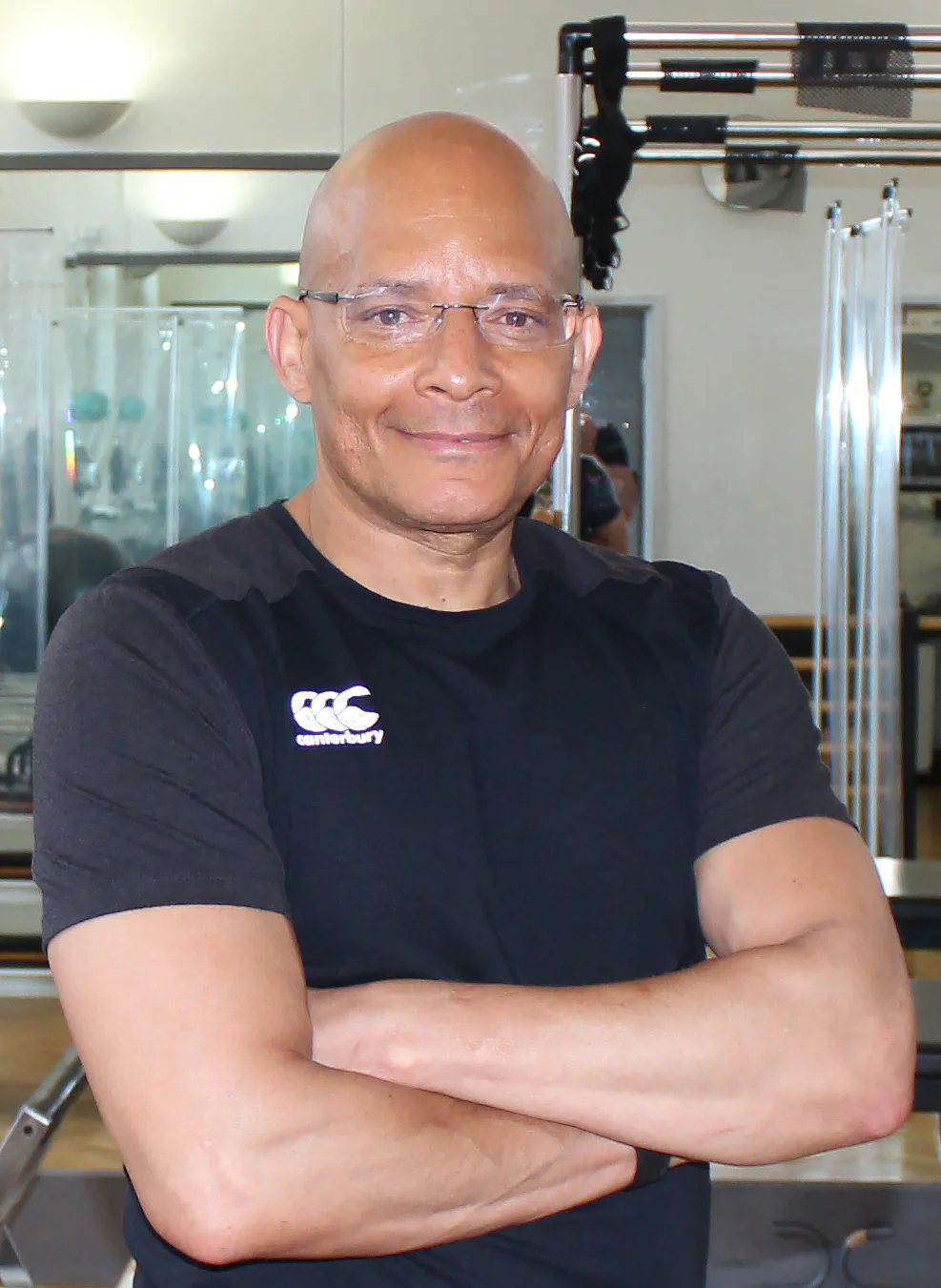
Teejay Sogunro
Founder, The Sogunro Practice · Applied Pilates & Osteolates Therapy · Published 21 Aug 2026 · 5 min read

Choosing the right Pilates studio — the questions that matter, from The Sogunro Practice, London Colney, St Albans.
Almost everyone who arrives at the studio has been given exercises before, usually by someone qualified to give them. The problem is rarely the exercise in isolation. It is that the exercise was chosen for the site of the symptom rather than for the stage of repair and the cause underneath it.
The same exercise can help or harm within a few weeks of itself. Nothing about how the area feels will tell you which, which is why an assessment has to come before the prescription rather than after the first flare-up.
This article sets out the four places where the same exercise can help or harm: stretching a repair before it has set, failing to stretch it once it has, strength taken too far in either direction, and range gained at the cost of stability.
Injured tissue lays down collagen and guards itself. That guarding feels like tightness, so the instinct — and often the advice — is to stretch it out.
The stiffness is often the repair, not the problem.
In the acute stage that is the worst available option. The new fibres have not set. Stretch into them and they tear, and the repair begins again from the start.
Every session resets the clock. The tightness returns, which feels like proof that more stretching is needed. It is the most self-confirming mistake in musculoskeletal rehabilitation.
Mechanical loading is what drives repair. Khan and Scott, writing in the British Journal of Sports Medicine, describe how controlled mechanical load is converted into cellular signals that stimulate tissue repair and remodelling. Correctly dosed exercise does not merely avoid harm to a healing structure; it actively improves the quality of the repair.
Timing changes the outcome, not just the speed. Killian and colleagues, reviewing the mechanobiology of tendon healing, show that altering the mechanical environment alters how the tissue heals, and that both insufficient and excessive loading degrade the result.
Rest is no longer the default alternative. Bleakley, Glasgow and MacAuley proposed replacing PRICE with POLICE — Protection, Optimal Loading, Ice, Compression, Elevation — precisely because the loading decision, not the resting decision, is the one that determines recovery.
Prescribed Pilates outperforms most other exercise. Two network meta-analyses — Owen and colleagues across 89 trials, Hayden and colleagues across 217 — found Pilates among the most effective exercise treatments for chronic low back pain. Both reviews included only programmes prescribed or planned by a health professional. That is the distinction that matters: the evidence is for exercise chosen for the individual, not for attending a class.
“Without the necessary foundation in anatomy, musculoskeletal movement and associated pathologies, the most well-intentioned instructor will be unable to define an appropriate routine for each individual. If your instructor doesn’t understand the clinical nature of a prolapsed disc, sciatica or facet joint syndrome, clearly they won’t understand which exercises will aggravate or worsen your condition.”
Scar tissue repairs strong but disorganised — the fibres lie in every direction rather than along the lines the tissue actually has to work in. At this stage gentle, progressive stretching is exactly what it needs. It remodels those fibres along the lines of load, and the repair finishes better than it would have on its own.
Once the collagen is laid down, it reverses.
Same movement. Weeks apart. Opposite result. That single fact is the clearest argument I know for assessing before prescribing, because you cannot read the stage of repair from the symptom.
Ligaments creep, and they recover slowly. Solomonow and colleagues measured lumbar viscoelastic laxity following prolonged cyclic loading and found that the resulting creep, together with the disturbed reflexive muscle activity accompanying it, took substantially longer to recover than the loading itself lasted. Range acquired this way is not range earned. It is a temporary loss of passive restraint.
Ligament is not muscle, and does not behave like it. Frank’s review of ligament structure and physiology sets out why: ligaments are specialised connective tissue that adapts slowly, and whose mechanical behaviour differs fundamentally from contractile tissue. Treating a ligament with the stretching strategy you would use on a muscle is a category error.
Static stretching has a measurable acute cost. Behm and Chaouachi’s review of the acute effects of static and dynamic stretching found consistent reductions in force and power output after prolonged static stretching. Stretch changes a muscle’s mechanical behaviour, not simply how it feels.
Muscle can compress nerve. Piriformis syndrome is the clearest documented instance: Probst, Stout and Hunt’s narrative review describes sciatica generated by compression of the sciatic nerve by the piriformis muscle itself. A muscle worked in the wrong direction is not a neutral event for the structures passing through and around it.
At The Sogunro Practice, the maximum of 7 clients per session is a hard limit. At 7, every client can be observed, corrected and remembered between sessions. That limit exists because of clinical understanding of the Reformer and MSK rehabilitation — not as a marketing claim.
Strength has the same two-sided problem, and it catches people who are doing everything they were told to do.
Why the same exercise can help or harm: too weak, or too strong.
A muscle that cannot hold its job leaves the joint unstable, and instability is its own source of pain and of further injury. That much is widely understood.
Taken too far the other way, though, a muscle shortens and compresses. Compression is how a nerve ends up impinged — and the person doing the strengthening usually believes they are doing the safe, conservative thing. Strength is not the goal. The right amount, in the right muscle, is.
“Effective instruction is not about delivering an entertaining variety of exercises to maintain client or group interest. It is about the application of the right exercise. Without the necessary foundation in anatomy, musculoskeletal movement and associated pathologies, the most well-intentioned instructor cannot define an appropriate routine for each individual.”
At The Sogunro Practice, the starting point for every new client is a £85 1-to-1 Movement Assessment — a 60-minute one-to-one session that identifies the specific drivers of each client’s issue. Only after that assessment does a programme begin. By the time a client enters a small group session, Teejay already knows how they move, what is driving their pain or limitation, and which exercises are appropriate or contraindicated for them specifically.
Stretch a ligament and it stays long. Ligaments have poor elastic recovery, so that is not range gained — it is passive support lost, and the joint has less holding it together than it did before.
Too much range is its own error — the fourth way the same exercise can help or harm.
Overstretch a muscle often enough and it loses its recoil. It stops returning energy and starts handing its work to tissue that was never built to do it.
What qualifications does the instructor hold, and do they include rehabilitation training?
Do you understand the clinical nature of my specific condition?
Which exercises in your programme would be contraindicated for my condition?
How many clients are in a group session?
Is there a Movement Assessment before I start?
What is your experience working with my specific condition?
What does a progressive exercise plan look like for my condition specifically?
How The Sogunro Practice approaches this
25 years of clinical practice. The full STOTT Pilates apparatus. Maximum 7 clients. Assessment before everything.
Stretching
STOTT Pilates Full Comprehensive & Rehabilitation Certified. Qualified Sports Therapist. Certified Physio Club Rehab Trainer & Master Rehab Trainer. Studied osteopathy, Middlesex University. Watford FC Rehab Pilates Sports Therapist 2015–2018.
Experience
25 years professional clinical practice. 35 years total experience. Founded 2001. Creator of Osteolates Therapy. 4.9 ★ on Google · 123 reviews. Many clients attending for 10–14 consecutive years.
Class size
Maximum 7 clients per session. Hard limit, not a target. Every client is observed, corrected and known individually throughout the programme.
Assessment
£85 / 60-minute Movement Assessment before any programme begins. Identifies the specific drivers of your condition. No group session until assessment is complete.
About the author
Teejay Sogunro
Founder, The Sogunro Practice · Applied Pilates & Osteolates Therapy, London Colney, St Albans
STOTT Pilates Full Comprehensive and Rehabilitation certified. Qualified Sports Therapist. Certified Physio Club Rehab Trainer & Master Rehab Trainer. Studied osteopathy, Middlesex University. Rehab Pilates Sports Therapist, Watford FC 2015–2018. England Over-60s International Squash Representative, Top 32 World Ranked 2024. Founded The Sogunro Practice 2001. Creator, Osteolates Therapy. 25 years professional clinical practice and 35 years total experience.
Related articles & condition guides
Start with the assessment.
Everything else follows from it.
None of this is readable from the symptom. It is readable from the stage of repair, the tissue involved, and the cause rather than the site of the pain. A 60-minute 1-to-1 Movement Assessment with Teejay identifies what is specifically driving your condition. No group session until that is complete. Free parking on site. 2 minutes from M25 J22.
The Sogunro Practice · Applied Pilates & Osteolates Therapy
Unit 5, Hertfordshire Business Centre, Alexander Road
London Colney · St Albans · Hertfordshire · AL2 1JG