
Caution about large group
Pilates classes. “Reformer Pilates craze is stretching us to breaking point.” — The Sunday Times, June 2024
Applications from new self-employed reformer Pilates instructors rose by 948% between 2024 and 2025. Injuries are rising in step. The Guardian, the Evening Standard, the Daily Mail and the Sunday Times have all investigated. Industry bodies are warning of a “wild west” of underqualified instructors, overfilled studios and a growing number of preventable injuries. Here is what is happening and what to look for.
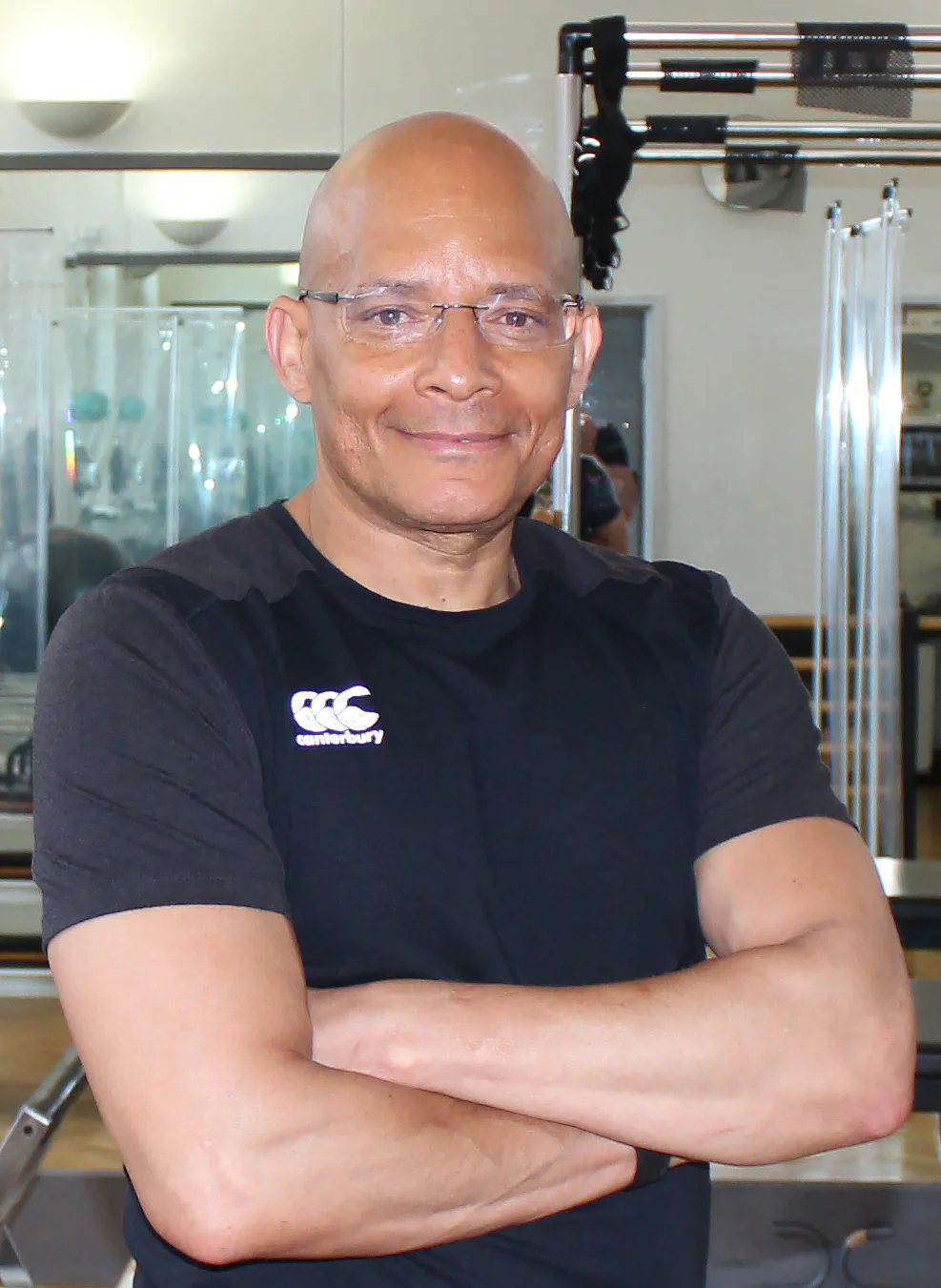
Teejay Sogunro
Founder, The Sogunro Practice · Applied Pilates & Osteolates Therapy · Published 23 Jul 2025 · Updated 27 Jul 2026 · 7 min read
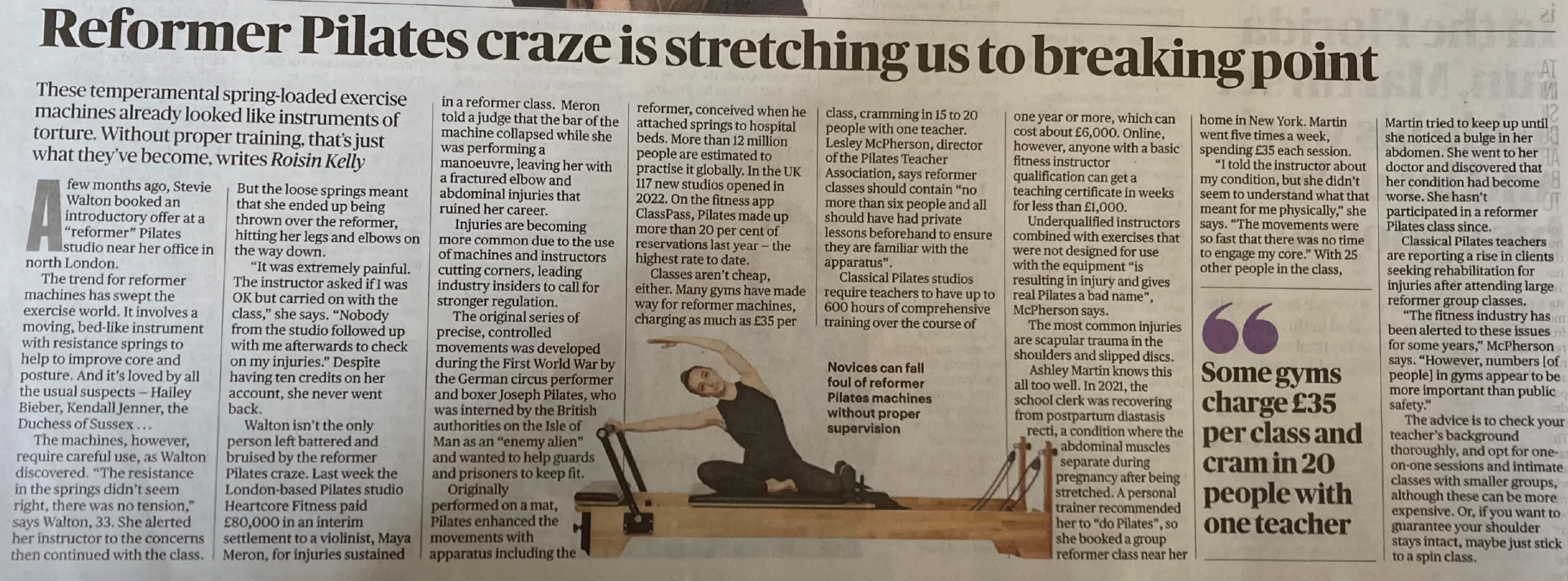
“Reformer Pilates craze is stretching us to breaking point” — The Sunday Times, 16 June 2024, Roisin Kelly.
The Reformer Pilates boom is real. Pilates was the most booked class on ClassPass for three consecutive years, with a 66% increase in bookings in 2025 alone. Between 2024 and 2025, applications for instructor insurance from self-employed Reformer teachers rose by 948%. The Sunday Times, the Guardian, the Evening Standard and the Daily Mail have all investigated what that growth is doing to the quality and safety of what is being delivered inside those studios.
The answer is not reassuring. The Guardian (April 2026) described a “wild west” of unregulated studios. The Pilates Foundation warned that classes are “potentially dangerous in the hands of someone who has had a short period of training.” The Pilates Teacher Association criticised the expansion as being accompanied by shortcuts in training and a decline in qualification standards. HFE, a leading fitness education provider, confirmed it had been contacted by litigants and legal professionals about a growing number of injury cases from Reformer classes. Industry body EMD UK issued formal guidance on Reformer class safety.
This article explains why large group Reformer Pilates classes carry specific risks, what the documented injury evidence shows, and what to look for when choosing a studio — particularly if you have a musculoskeletal condition.
The scale of the boom
The numbers behind the UK’s Reformer Pilates explosion.
The growth of Reformer Pilates in the UK has been extraordinary by any measure. What was a niche specialist discipline a decade ago has become a mainstream consumer product, with boutique studios opening at a rate that outpaces the availability of properly qualified instructors to staff them.
The speed of this expansion has created a structural problem. Demand for instructors has far outpaced supply. In response, some operators have introduced rapid in-house training programmes to fill their rosters. The result is that an increasing proportion of the UK’s Reformer Pilates classes are being delivered by instructors whose training time is measured in days or weeks rather than years.
Pilates Foundation: Classes are “potentially dangerous in the hands of someone who has had a short period of training” and there have already been documented cases of injuries in these classes.
Pilates Teacher Association: The rapid commercial expansion of Reformer Pilates has been accompanied by shortcuts in training and a decline in qualification standards. The expansion of commercial interests has driven this decline.
UK regulation: In the UK, individuals can legally describe themselves as Pilates instructors without any formal qualifications. While reputable studios typically require recognised certifications including Level 3 qualifications covering mat work and anatomy, this is not consistently enforced. No statutory body regulates who may call themselves a Pilates instructor or what training they must hold.
HFE (Aug 2025): “There is a call for the public to be more aware of the risks in an environment where the focus is on apparatus, and gyms and fitness instructors ‘cutting corners.’”
The injury evidence
Documented injuries and litigation — what the evidence shows.
The Reformer is a complex piece of moving apparatus: a sliding carriage with adjustable spring tension, moveable footbar, straps attached to pulleys and multiple setup configurations that vary between exercises. It was designed by Joseph Pilates for one-to-one or very small group instruction, where each client’s setup, technique and safety can be individually monitored.
When used in large groups with insufficiently trained instructors, the gap between the apparatus’s complexity and the supervision available creates predictable injury risk.
Maya Meron case (2019, Heartcore studio): Violinist Maya Meron suffered severe abdominal injuries, a fractured elbow and long-term nerve damage after a faulty Coreformer machine collapsed during a class. She was left unable to play the violin professionally. She sued the studio and was awarded interim damages of £80,000 for what could have been a career-ending injury.
Range of injuries documented in 2025 reporting (The Standard, Daily Mail, HFE, Guardian): tendon tears, fractures, slipped discs, shoulder injuries, back injuries and other serious and debilitating conditions. TikTok carries numerous videos of people falling from Reformer machines.
HFE confirms multiple ongoing legal cases and personal injury claims related to Reformer classes, with litigants and legal professionals seeking advice and commentary. The firm describes the trend as a continuing and accelerating problem.
EMD UK (Feb 2026): “When delivered safely, Reformer Pilates is transformative. But without the right checks, it also carries one of the highest injury risks of any class on the studio schedule. From spring tension to carriage control, there’s a lot going on under the surface — and a lot that can go wrong without trained supervision.”
Body Control Pilates: “It is impossible for an instructor to keep an eye on what everyone is doing at any given moment in time in such [large] classes, so there is a much-increased risk of accidents and injury.” The organisation notes that large classes are often the first experience many clients have on a Reformer, with very little focus on the safety aspects of working on the apparatus.
EMD UK on equipment hazards: Spring tension affects resistance, stability and movement control — the wrong load can cause injury. Foot bar position must be checked before each exercise change. Carriage rebound, strap tension and spring selection all require individual setup. In a large group class, an instructor cannot individually verify these for every participant on every exercise change.
Gill Cummings-Bell MA, MSc, PGCE: “In my experience when participant numbers on Reformer increase above 10 in class this isn’t possible [to observe technique]. As a very experienced teacher with a great movement diagnostic eye, I struggle with more than 10 on Reformer.”
“Smaller is always better when it comes to Reformer. Ideally you want your instructor to have eyes on every single person in the room, at every moment.”
Five specific risks
Why large group Reformer classes carry risks that small classes don’t.
The problem with large group Reformer classes is not that Reformer Pilates is inherently dangerous. The problem is structural — rooted in the mismatch between the complexity of the apparatus, the variability of participant bodies and histories, and the supervision capacity of a single instructor managing 15–20+ people simultaneously.
The Sogunro Practice — why 7
Maximum 7 clients. Not a target. A hard clinical limit.
At 7 clients on the Reformer, Teejay can see every person in the studio at every moment. He can observe technique, catch a form breakdown in real time, adjust spring settings for each individual between exercises, and remember every client’s history, condition and progression from one session to the next.
The 7-client limit exists because of what the Reformer is. It is not a group fitness machine. It is a precision rehabilitation apparatus with moving parts, adjustable resistance and significant injury potential when used without proper individual supervision. The commercial model that fills studios with 20 clients maximises revenue. It does not maximise safety, quality or results — for anyone, and especially not for the majority of Pilates participants who have some form of MSK issue.
Every new client at The Sogunro Practice begins with a £85 Movement Assessment before any group session. This establishes what is driving their specific issue, which exercises are contraindicated for them, and how their programme should be sequenced. By the time a client joins a group, Teejay already knows them. That is not possible in a class of 20.
What to look for
The practical checklist before booking a Reformer class.
The Guardian, HFE and EMD UK have all identified the same practical markers that distinguish a safe, well-run Reformer studio from a commercial operation cutting corners on safety. These are the questions worth asking before booking.
- ✓What is the maximum class size? On Reformers, meaningful individual observation becomes impossible above 10. Specialist rehabilitation studios operate at 7 or fewer.
- ✓Is there a Movement Assessment before your first session? Any studio placing new clients on a Reformer without assessing their history, conditions and movement patterns first is not operating at a safe rehabilitation standard.
- ✓What qualifications does the instructor hold? A Level 3 Mat Pilates qualification does not cover Reformer use. Look for recognised Reformer certification from STOTT Pilates, Pilates Foundation or equivalent, plus additional MSK rehabilitation training for clinical populations.
- ✓Is this an in-house qualification from the studio brand? In-house training programmes are not equivalent to industry-recognised qualifications. Several major operators run these specifically to address instructor shortages. Virgin Active’s job adverts specifically note this distinction.
- ✓Do you have a musculoskeletal condition? If so, a large group class is high risk regardless of the studio’s reputation. The exercises cannot be individually modified in a class of 15–20. Back pain, sciatica, facet joint syndrome, hypermobility and post-surgery rehabilitation all require individual prescription — not group programming. Full studio selection guide →
- ✓Is the equipment properly maintained? Faulty or poorly maintained Reformer machines are a documented cause of injury. Legal professionals investigating Reformer claims specifically highlight inadequate equipment maintenance as a contributing factor in multiple cases.
From 25 years of clinical practice
What I see in clinic that confirms what the media has been reporting.
This is not a new observation from The Sogunro Practice. The concern about large group Pilates classes predates the current boom — and the current boom has simply made the problem more visible and more common.
A significant number of new clients who arrive at The Sogunro Practice have been to large group Reformer classes before coming here. Many arrive having experienced worsening symptoms, new injuries or simply no improvement from months of classes that they hoped would help their back pain, sciatica or post-surgery recovery. The pattern is consistent: they were placed in a group without assessment, the class could not be modified for their specific condition, and the exercise either made no difference or made things worse.
“When classes grow beyond a handful of clients, the instructor cannot watch every person. This is not a criticism of the instructor. It is physics. Seven clients is the number at which I can see everyone, know everyone, and do the work properly.”
The solution is not for large group studios to stop existing. For generally healthy adults without significant MSK issues, a well-run larger group class may be perfectly adequate. The problem is the mismatch between what those classes offer and what people with musculoskeletal conditions actually need — and the fact that the two populations are mixed together in the same class without any differentiation.
Applied Pilates at The Sogunro Practice is not for everyone. It is for people who have a specific condition to manage, a specific rehabilitation goal to reach, or a history of not getting results from generic fitness approaches. For that population, group size and individual clinical knowledge are not preferences — they are the clinical minimum.
About the author
Teejay Sogunro
Founder, The Sogunro Practice · Applied Pilates & Osteolates Therapy, London Colney, St Albans
STOTT Pilates Full Comprehensive and Rehabilitation certified. Qualified Sports Therapist. Certified Physio Club Rehab Trainer & Master Rehab Trainer. Studied osteopathy, Middlesex University. Rehab Pilates Sports Therapist, Watford FC 2015–2018. England Masters squash representative, world ranked over-60s. Founded The Sogunro Practice 2001. Creator, Osteolates Therapy. 25 years professional clinical practice and 35 years total experience.
Related articles & condition guides
The right Pilates for
your specific situation.
Start with a £85 Movement Assessment. Teejay identifies your specific condition, establishes what exercises are appropriate, and builds a programme around your actual presentation — not a class format. Free parking. 2 minutes from M25 J22.
The Sogunro Practice · Applied Pilates & Osteolates Therapy
Unit 5, Hertfordshire Business Centre, Alexander Road
London Colney · St Albans · Hertfordshire · AL2 1JG