
The gap between fear and habit
Respecting the precautions is our job, not another thing for you to police.
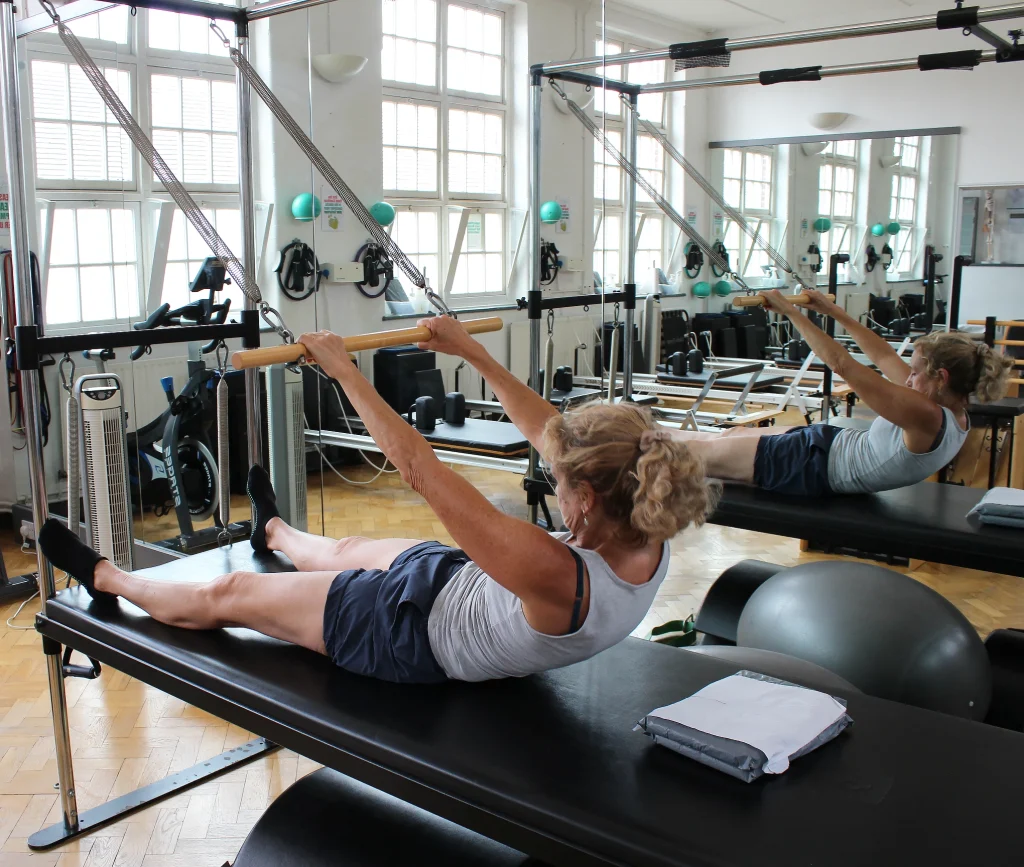
Hip precautions are real, and we work inside them as a matter of course — that is the point of being supervised rather than following a sheet at home. You do not have to hold the rules in your head, check yourself mid-movement, or guess whether what you are about to do is one of the forbidden ones. That is taken care of, which frees you to work considerably harder than you would ever dare to on your own.
And working harder is the part that gets missed. A brain that is frightened of a joint will not let it work properly, however well the surgery went — it restricts the range, holds the muscle back, and keeps the limp long after there is any mechanical reason for one. You cannot argue somebody out of that. What changes it is being encouraged to try something slightly harder than you believed you could, in conditions safe enough that it goes well, and then again the week after. Knowing when someone is ready for that, and when they need holding back another week, is judgement built over thirty-five years.
"Almost everyone is afraid of dislocating it. Almost nobody respects the precautions as carefully as they think they do. Both of those are solvable in a supervised session."
Applied Pilates and Osteolates Therapy are movement-based rehabilitation services. This page is for people recovering from hip replacement surgery. The work runs alongside your surgeon and physiotherapist — never instead of them.

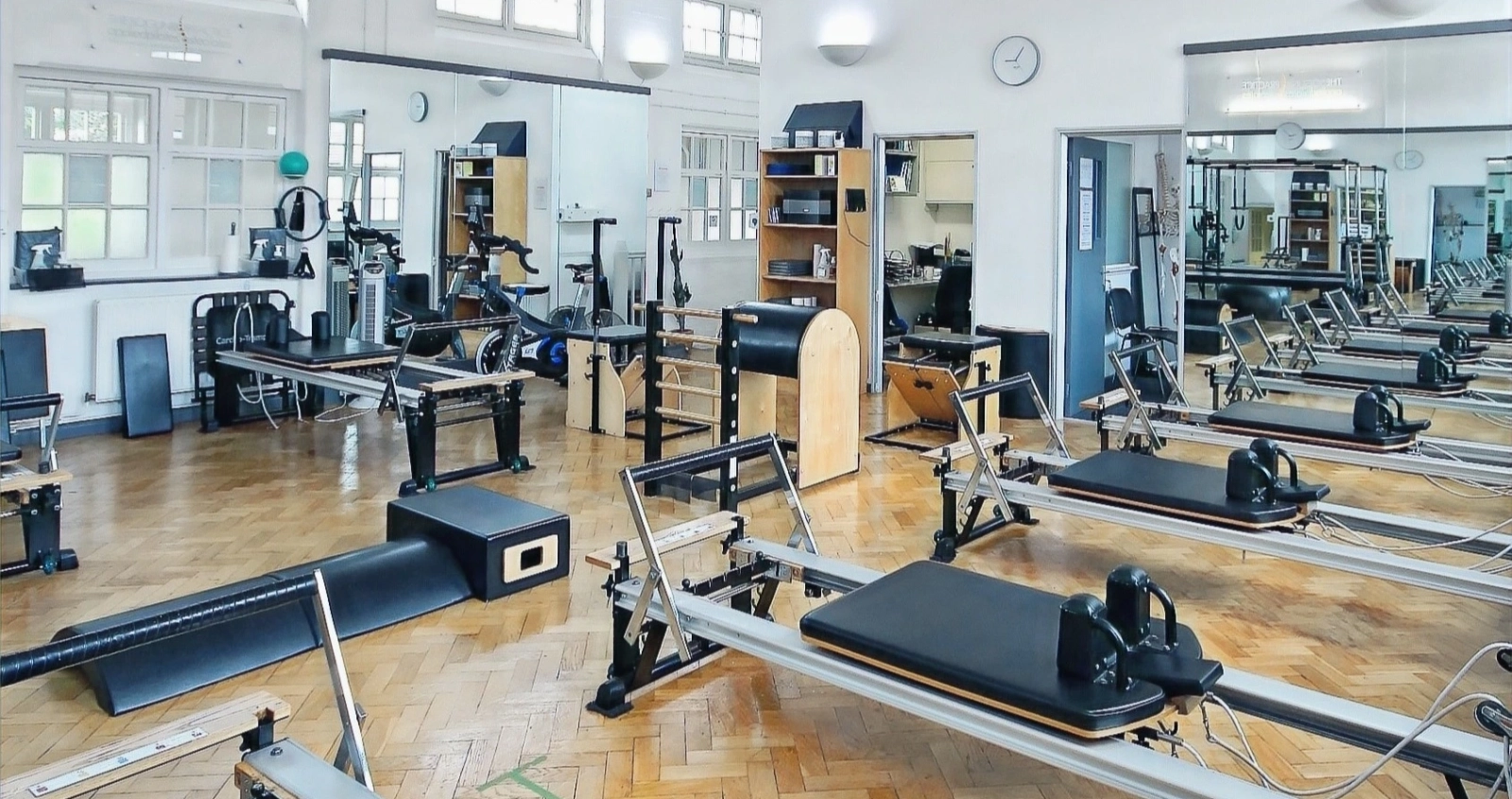
The apparatus suite
Load without weight — and without breaking the rules.
Spring resistance is what makes early hip work possible. On a leg press or in a class, load and body weight arrive together, so the hip has to carry you before it can be strengthened. The Reformer, Cadillac, Chair and Barrels load the muscle while supporting the joint — and just as importantly, they let the movement be set up for you, with the range fixed, the direction controlled and the position chosen, so that hard work happens well inside whatever restrictions you have been given. Resistance changes in small steps, in both directions, during the session rather than after it.
Where our part ends
When we stop,
and send you back.
Some things are not ours to treat, and knowing which is part of working properly alongside your surgical team. If anything suggests a possible clot we stop immediately and send you to your GP, your surgeon or urgent care that day — DVT is a recognised risk after hip surgery and it is an emergency, not something to train around. If strength and mobility are not moving over a reasonable stretch of time despite consistent work, that is information for your surgeon rather than a reason for more exercise. And if the way the joint behaves under load concerns us, we say so and ask your clinician to look at it. None of this replaces your medical care; it runs alongside it, and it defers to it.
| What matters | Standard Reformer studio | Applied Pilates St Albans |
|---|---|---|
| Apparatus | Reformer only | Full STOTT Pilates suite — 6+ apparatus ✓ |
| Group size | 10–13 clients | Maximum 7 clients ✓ |
| Programme | Fixed class — same for everyone | Built on your Movement Assessment ✓ |
| Instructor training | Reformer-only qualification | STOTT Pilates full comprehensive — 4+ years ✓ |
| Approach | Fitness and wellness | Rehabilitation-informed clinical ✓ |
| Osteolates Therapy | Not available ✕ | Integrated hands-on treatment ✓ |
| Suitable for chronic pain | Not designed for it ✕ | Specifically designed for back pain, sciatica ✓ |
| Parking | Varies ✕ | Free parking on site ✓ |
What the assessment finds
The muscles that switched off —
and never switched back on.
A hip that has hurt for years teaches the muscles around it to stop working. The glutes give up first, the hip flexors shorten and weaken, and the muscles of the lower leg quietly take on work that was never theirs. Replacing the joint removes the pain. It does not switch any of that back on. The assessment is there to find which muscles have been inhibited and in what order they need waking up — and to see what the rest of you has been doing to compensate, because the other hip, both knees and the lower back have usually been absorbing an uneven gait for a very long time.
Twelve to twenty-four weeks to a hip you stop thinking about — though most people leave the first session already moving differently.
Independent reviews
Rated 4.9 by 123 people in St Albans.
Your journey
Three steps to lasting relief.
Every client begins the same way — with an honest assessment of which muscles have switched off, and what the hip is ready for.
Everything you need before you book
Common questions
Questions about Pilates
after hip replacement
- At The Sogunro Practice in London Colney: Movement Assessment £85, 1-to-1 sessions £95 each, or from about £79 per session on the 6-session course, small group PAYG £32, and monthly membership from £129/month. Osteolates Therapy from £65. Every session uses the full STOTT Pilates apparatus with a maximum of 7 clients and a programme built around your Movement Assessment. Full pricing →
- Usually from about six weeks, once your surgeon has cleared you. Some people come in earlier for the assessment alone, so that a programme is ready to begin the moment clearance arrives. Most attend once or twice a week after that.
- Some of it will be uncomfortable, and that is expected — muscle that has not worked properly in years protests when you wake it up. What should not happen is joint pain that lingers or worsens. Knowing which is which, in the moment, is what the supervision is for.
- We work inside them. Your restrictions are established at the assessment and respected in every session, so you are not the one policing them mid-exercise. It is one of the main practical advantages of supervised apparatus work over a sheet of exercises at home.
- It is the stage after it. Physiotherapy gets you safely through the early weeks and discharges you once you have met the milestones. What follows — rebuilding strength and confidence to the point where you stop thinking about the hip — takes longer than a standard block allows.
- Unit 5, Hertfordshire Business Centre, Alexander Road, London Colney, St Albans, AL2 1JG. Ample free parking on site. 2 minutes from M25 junction 22. Approximately 10 minutes from St Albans, Radlett, Hatfield, Bricket Wood, Shenley and Colney Heath — around 15 minutes from Barnet and Edgware, and within a 10-mile drive of Harpenden, Watford, Borehamwood, Wheathampstead, Redbourn and Welwyn Garden City. Map and full directions →
- Yes, and it genuinely improves the programme. Many clients bring notes, a discharge summary or scan results to the assessment, and we work with what you have been advised rather than around it. We do not diagnose and we do not replace medical care — we take over once the diagnosis exists and your clinician has done their part.
- It changes the sequence, because there is no fully reliable side to work from. It is very manageable — it simply needs a different order, and establishing that order is one of the things the assessment does.
- Sessions run Monday to Thursday from 7:30am to 7:30pm, Friday from 7:30am to 5:30pm, and Saturday from 7:30am to 1:30pm. View the full timetable →
Start with the
£85 Movement Assessment.
60 minutes, 1-to-1 with Teejay. We will find out which muscles have stopped working — and what you can safely start asking of the hip.
The Sogunro Practice · Applied Pilates & Osteolates Therapy
Unit 5, Hertfordshire Business Centre, Alexander Road
London Colney · St Albans · Hertfordshire · AL2 1JG · Free parking on site