

★★★★★
Desk posture pain“I’d had monthly massages for years and the tension always came back within a week. Teejay found the actual postural pattern causing it, and within a few weeks the tightness simply stopped returning.”
"My shoulders and neck are permanently tight, no matter how many massages I have." Massage relieves tension. It rarely changes the posture and movement pattern causing it.
Understanding the cause
Shoulder and neck pain are among the most common reasons clients come to The Sogunro Practice in St Albans. However, the underlying cause is rarely the shoulder or neck itself. It is usually a postural pattern — rounded shoulders, a forward head position, or a stiff upper back — that has built up gradually over years.
Treatments that focus only on the painful area tend to provide temporary relief at best. Tight chest muscles and weak mid-back stabilisers frequently pull the shoulders forward, placing chronic strain on the neck — the neck takes the blame for a postural problem elsewhere in the chain.
"A tight neck is rarely the problem on its own. It’s usually compensating for a stiff upper back or weak shoulder blades that aren’t doing their job."
Every new client starts with a thorough Movement Assessment to understand how posture, shoulder mechanics, and upper back mobility are working together before any exercise is prescribed.
Common causes
Each cause shapes how the condition is managed — which is why a thorough assessment matters before any treatment plan begins.
Understanding the anatomy
Shoulder and neck pain are frequently linked through the postural chain. Understanding which structures are involved shapes exactly how your programme is built.
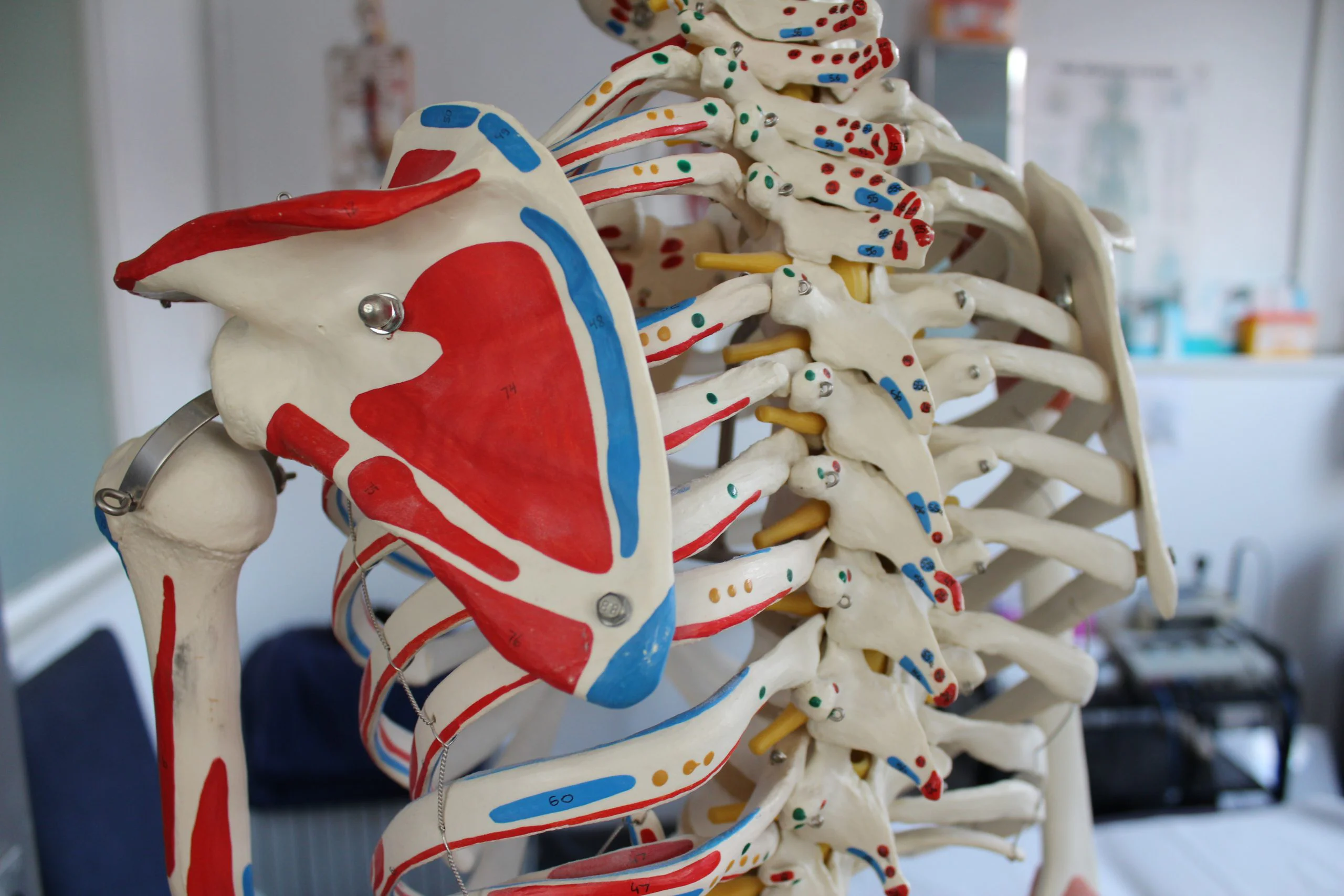
Shoulder-neck postural chain — how imbalance drives pain
Forward head posture adds 3–5kg of load per centimetre forward onto the cervical spine structures. Tight chest and upper traps pull the shoulders forward while weak scapular stabilisers and deep neck flexors cannot counteract them. A stiff thoracic spine forces the neck and shoulders to compensate for all of it.
Recognising the pattern
Symptoms vary depending on the underlying cause and how long the pattern has been building. Most clients experience some combination of the following.
The critical distinction
Shoulder and neck pain rarely resolves with a single technique. In particular, the most commonly tried approaches — massage, stretching, or isolated strengthening — frequently miss the pattern maintaining the problem.
Stretching the neck and upper traps feels good temporarily. Without strengthening the weak mid-back muscles pulling against them, the tightness simply returns within days.
A stiff thoracic spine often forces the neck and shoulders to compensate. Treating only the neck while ignoring upper back mobility rarely resolves the underlying pattern.
Introducing overhead shoulder exercises before scapular control is established can aggravate impingement rather than resolve it. The sequence matters as much as the exercise.
The treatment pathway
Shoulder and neck pain rarely resolves with a single technique applied in isolation. With the right combination at each stage, most clients achieve significant and lasting relief.
Client results
“I’d had monthly massages for years and the tension always came back within a week. Teejay found the actual postural pattern causing it, and within a few weeks the tightness simply stopped returning.”
“I have been going to The Sogunro Practice for the past 10 years, doing Applied Pilates twice a week. It makes a huge difference to my overall health, strength and balance.”
“I couldn’t reach overhead without pain for months. Teejay worked on my shoulder blade control first, and the impingement pain resolved before we even touched the painful movements directly.”
Getting started
Every client begins the same way — with an honest assessment of what is actually driving the tension.
Why trust Teejay Sogunro with your shoulder & neck pain
Related pages & information
Common questions
Your £85 Movement Assessment is a 60-minute 1-to-1 with Teejay. He’ll assess your posture, shoulder mechanics and upper back mobility, explain what he finds, and give you a clear, honest plan. No generic advice. No obligation to continue. Ample free parking on site.
The Sogunro Practice · Applied Pilates & Osteolates Therapy
Unit 5, Hertfordshire Business Centre, Alexander Road
London Colney · St Albans · Hertfordshire · AL2 1JG · Free parking on site