
You were getting better. Then you stopped. Nobody has explained why. Why recovery stalls after physio — and what each cause actually needs.
Recovery stalls after physio more often than anyone admits. Treatment worked, the pain settled, you were given exercises — and then progress flattened. There are three reasons, and a fourth sits underneath all of them.
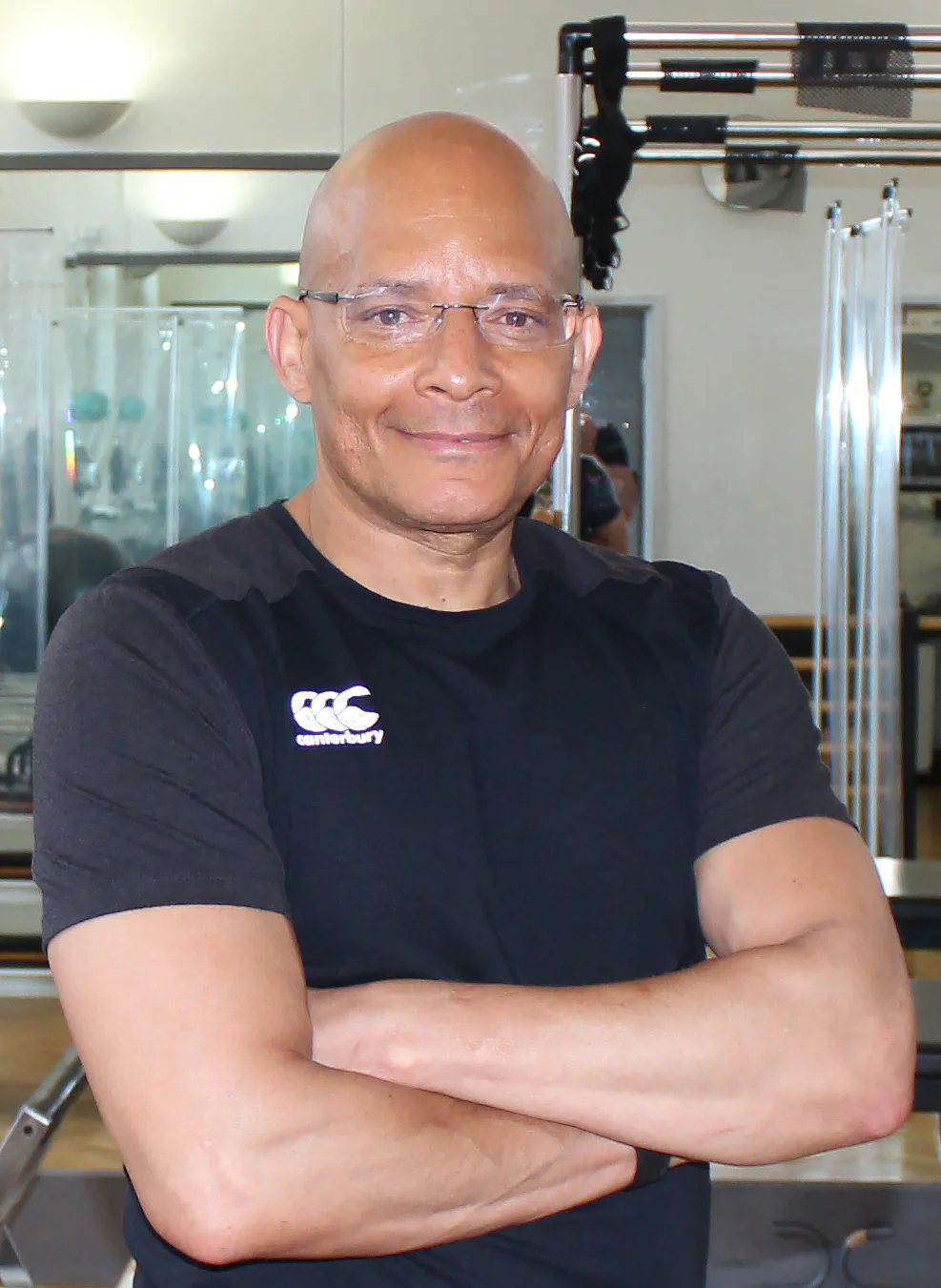
Teejay Sogunro
Founder, The Sogunro Practice · Applied Pilates & Osteolates Therapy · Published 21 Aug 2026 · 5 min read

Recovery that has stalled after treatment — The Sogunro Practice, London Colney, St Albans.
It is one of the most common stories we hear. Treatment worked — the physiotherapy, the osteopathy, the chiropractic, the surgery. The acute pain settled. You were given exercises and told to keep going. And for a while, you did get better.
Then progress flattened. Not back to square one, but not right either. You are still guarding it, still working around it, still not doing the things you stopped doing. And nobody has given you an account of why.
Recovery stalls after physio for three reasons, and none of them is that you did not try hard enough.
This is for people who have finished treatment, improved, and then stopped improving. It explains what the exercise sheet left out, why caution quietly becomes the obstacle, and what changes when someone watches you move for an hour rather than twenty minutes.
Your exercises came on one sheet. They follow opposite rules.
Almost every rehabilitation programme mixes two entirely different kinds of work, and they are almost never labelled. Strengthening does not make you stronger during the session — it makes you stronger in the recovery afterwards, while the muscle repairs. Protein synthesis stays elevated for roughly 24 to 48 hours after the work, which is why the same muscle group needs a day off in between. Take that gap away and you accumulate fatigue instead of strength: working hard, feeling sore, gaining very little.
Mobility work carries no such requirement. It is not producing the fatigue that strengthening produces, so it does not need a recovery day between sessions — it can be done daily, and often twice daily. What builds the gain is consistency across weeks rather than any single session.
Mechanical loading is the signal that drives tissue remodelling and repair (Khan & Scott, Br J Sports Med 2009; PMID 19244270). Tissue changes in response to what it is asked to do.
Timing changes the outcome, not just the speed. Killian and colleagues, reviewing the mechanobiology of tendon healing, show that altering the mechanical environment alters how the tissue heals, and that both insufficient and excessive loading degrade the result.
Rest is no longer the default alternative. Bleakley, Glasgow and MacAuley proposed replacing PRICE with POLICE — Protection, Optimal Loading, Ice, Compression, Elevation — precisely because the loading decision, not the resting decision, is the one that determines recovery.
Prescribed Pilates outperforms most other exercise. Two network meta-analyses — Owen and colleagues across 89 trials, Hayden and colleagues across 217 — found Pilates among the most effective exercise treatments for chronic low back pain. Both reviews included only programmes prescribed or planned by a health professional. That is the distinction that matters: the evidence is for exercise chosen for the individual, not for attending a class.
Now picture the sheet you were given, with both kinds of exercise on it and no distinction drawn. Most people do the whole list every day, because more feels like it must be better. Others do the whole list twice a week, because that is when they have time. Either way, half the programme is being done wrong — the strengthening never gets the recovery it needs, or the mobility work is rationed as though it did. You can follow your exercises faithfully for months, exactly as written, and still stall.
More range is not more progress.
The instinct when something feels tight is to stretch it further, and to keep stretching. Sometimes that is right. Often it is the opposite of what the joint needs.
Range without the control to manage it leaves a joint less stable, not more — and ligaments that have repeatedly been taken past their working length do not simply spring back. It is entirely possible to stretch your way into an unstable joint and a fresh problem, while believing you are doing the diligent thing. Sustained and repeated loading produces creep in ligaments and reduces the reflexive muscle activity that protects the joint, with full recovery taking 24 to 48 hours (Solomonow, J Electromyogr Kinesiol 2004; PMID 14759750).
Ligament is not muscle, and does not behave like it. Frank’s review of ligament structure and physiology sets out why: ligaments are specialised connective tissue that adapts slowly, and whose mechanical behaviour differs fundamentally from contractile tissue. Treating a ligament with the stretching strategy you would use on a muscle is a category error.
Pain-related fear predicts avoidance, disuse and disability independently of how much pain a person is actually in (Vlaeyen & Linton, Pain 2000; PMID 10781906).
Muscle can compress nerve. Piriformis syndrome is the clearest documented instance: Probst, Stout and Hunt’s narrative review describes sciatica generated by compression of the sciatic nerve by the piriformis muscle itself. A muscle worked in the wrong direction is not a neutral event for the structures passing through and around it.
Knowing when to stretch, when to stop stretching and when to strengthen instead is a judgement about your particular joint on a particular day. It is not a rule that can be written on a sheet.
Underneath both of those, there is usually something else going on.
And underneath both of those: you are frightened of it.
Very few people say this out loud, and almost everyone in this position feels it. You have had pain. You do not want it back. So you hold back — not consciously, not dramatically, just enough that the tissue is never asked to do anything demanding enough to change it.
That caution is sensible in the first weeks and becomes the problem later. Tissue adapts to what it is asked to tolerate. Ask nothing of it and it stays exactly where it is, and every month that passes makes the asking feel riskier.
You cannot be instructed out of this, and being told you are fine does not do it either. What changes it is being taken through something slightly harder than you believed you could manage, with someone watching, in conditions safe enough that it goes well — and then again the following week. Confidence is rebuilt the same way strength is: in increments, under supervision.
Which brings us to why the sheet could never have solved any of this on its own.
A programme written for week six cannot see you — the third reason recovery stalls after physio.
None of this reflects badly on the clinician who treated you — it reflects how the work is set up. Rehabilitation protocols are written for populations. They describe what a typical person can usually manage at six weeks, or twelve, and they are a reasonable starting point because they have to be. But people do not heal on a shared schedule: how strong you were beforehand, how long you compensated before anyone treated you, and how quickly your body lays down and remodels tissue all vary enormously between two people who had the same procedure on the same day.
What an hour changes when recovery stalls after physio.
We work one to one, for a full hour, once or twice a week. That is not a luxury — it is the mechanism, and it is the difference between a programme on paper and a recovery that moves.
An hour is long enough to watch how you actually move rather than how the sheet assumes you do. It is long enough to load something, see what happens, and change it there and then — dial the resistance down when today is not the day, or push further when you are plainly ready and did not know it. Spring-loaded apparatus makes that adjustment a matter of seconds rather than a decision to be revisited next appointment.
It is also long enough to settle the confusion the sheet created: which of your exercises need a rest day, which want doing every morning, what to stop stretching, and what to start loading. Given that, progress tends to resume on its own. Most people do not need to be pushed — they need someone to work out what they are ready for, tell them honestly that they are ready for it, and be there while they find out.
How The Sogunro Practice approaches this
25 years of clinical practice. The full STOTT Pilates apparatus. Maximum 7 clients. Assessment before everything.
Stretching
STOTT Pilates Full Comprehensive & Rehabilitation Certified. Qualified Sports Therapist. Certified Physio Club Rehab Trainer & Master Rehab Trainer. Studied osteopathy, Middlesex University. Watford FC Rehab Pilates Sports Therapist 2015–2018.
Experience
25 years professional clinical practice. 35 years total experience. Founded 2001. Creator of Osteolates Therapy. 4.9 ★ on Google · 123 reviews. Many clients attending for 10–14 consecutive years.
Class size
Maximum 7 clients per session. Hard limit, not a target. Every client is observed, corrected and known individually throughout the programme.
Assessment
£85 / 60-minute 1-to-1 Movement Assessment before any programme begins. Identifies the specific drivers of your condition. No group session until assessment is complete.
About the author
Teejay Sogunro
Founder, The Sogunro Practice · Applied Pilates & Osteolates Therapy, London Colney, St Albans
STOTT Pilates Full Comprehensive and Rehabilitation certified. Qualified Sports Therapist. Certified Physio Club Rehab Trainer & Master Rehab Trainer. Studied osteopathy, Middlesex University. Rehab Pilates Sports Therapist, Watford FC 2015–2018. England Over-60s International Squash Representative, Top 32 World Ranked 2024. Founded The Sogunro Practice 2001. Creator, Osteolates Therapy. 25 years professional clinical practice and 35 years total experience.
Related articles & condition guides
Start with the assessment.
Everything else follows from it.
None of this is readable from the symptom. It is readable from the stage of repair, the tissue involved, and the cause rather than the site of the pain. A 60-minute 1-to-1 Movement Assessment with Teejay identifies what is specifically driving your condition. No group session until that is complete. Free parking on site. 2 minutes from M25 J22.
The Sogunro Practice · Applied Pilates & Osteolates Therapy
Unit 5, Hertfordshire Business Centre, Alexander Road
London Colney · St Albans · Hertfordshire · AL2 1JG
References
The clinical points on this page — including why recovery stalls after physio — are drawn from the following peer-reviewed sources.
- Mixed muscle protein synthesis and breakdown after resistance exercise in humans. Am J Physiol 1997;273(1):E99-107
- Mechanotherapy: how physical therapists' prescription of exercise promotes tissue repair. Br J Sports Med 2009;43(4):247-52
- The role of mechanobiology in tendon healing. J Shoulder Elbow Surg 2012;21(2):228-37
- PRICE needs updating, should we call the POLICE? Br J Sports Med 2012;46(4):220-1
- Ligaments: a source of work-related musculoskeletal disorders. J Electromyogr Kinesiol 2004;14(1):49-60
- Ligament structure, physiology and function. J Musculoskelet Neuronal Interact 2004;4(2):199-201
- Fear-avoidance and its consequences in chronic musculoskeletal pain: a state of the art. Pain 2000;85(3):317-32
- Piriformis syndrome: a narrative review of the anatomy, diagnosis, and treatment. PM R 2019;11(Suppl 1):S54-63
- Some types of exercise are more effective than others in people with chronic low back pain: a network meta-analysis. J Physiother 2022;68(1):29-37